Table of Contents
ToggleChoosing exterior paint isn’t just about curb appeal, it’s about protection, durability, and getting the most out of a $5,000 to $10,000 investment. Home Depot stocks the widest selection of exterior paint formulas and colors under one roof, from trusted brands like Behr, Glidden, and PPG. Whether a homeowner is refreshing faded siding or completely transforming the look of their property, understanding color trends, paint technology, and selection tools can save time, money, and buyer’s remorse. This guide walks through what makes Home Depot the top choice for exterior paint, the hottest color trends for 2026, and how to pick a shade that lasts.
Key Takeaways
- Home Depot offers over 3,000 exterior paint colors across trusted brands like Behr, Glidden, and PPG, with same-day availability and free color-matching technology to ensure your selection works with existing home features.
- Trending exterior paint colors for 2026 shift toward warm greiges, earthy greens, deep moody blues, and soft off-whites, moving away from the stark grays and pale shades that dominated previous years.
- Behr Premium Plus Ultra is Home Depot’s most popular DIY choice with built-in primer and one-coat coverage potential, while Behr Dynasty and Marquee offer premium options for coastal climates and high-traffic areas.
- Use Home Depot’s free ProjectColor app to visualize paint colors on your actual home, test samples on north- and south-facing walls before committing, and consider fixed elements like roof and brick color when selecting your shade.
- Sheen selection matters for exterior durability: satin and eggshell work best for siding, while semi-gloss is ideal for trim and doors due to superior washability and protection from the elements.
- Choose neutral or classic colors for broader resale appeal, but balance personalization with long-term value—trendy exterior paint colors can narrow the buyer pool when it’s time to sell.
Why Home Depot Is the Go-To Destination for Exterior Paint
Home Depot carries over 3,000 exterior paint colors across multiple brands, all available in-store and online. That selection beats most independent paint retailers and gives homeowners the ability to compare formulas, sheens, and price points side-by-side without driving across town.
The color-matching technology at Home Depot is another major advantage. Bring in a fabric swatch, a roof shingle, or a photo, and the spectrophotometer can match it to the closest available color or create a custom tint. This is especially useful when matching existing trim or coordinating with fixed elements like brick or stone.
Same-day availability is a big deal for DIYers working on tight schedules. Most locations stock gallons of popular Behr and Glidden colors ready to go, and custom mixes are usually ready in under 15 minutes. Contractors and pros can also access bulk discounts and five-gallon buckets, which reduce per-gallon costs and ensure color consistency across large jobs.
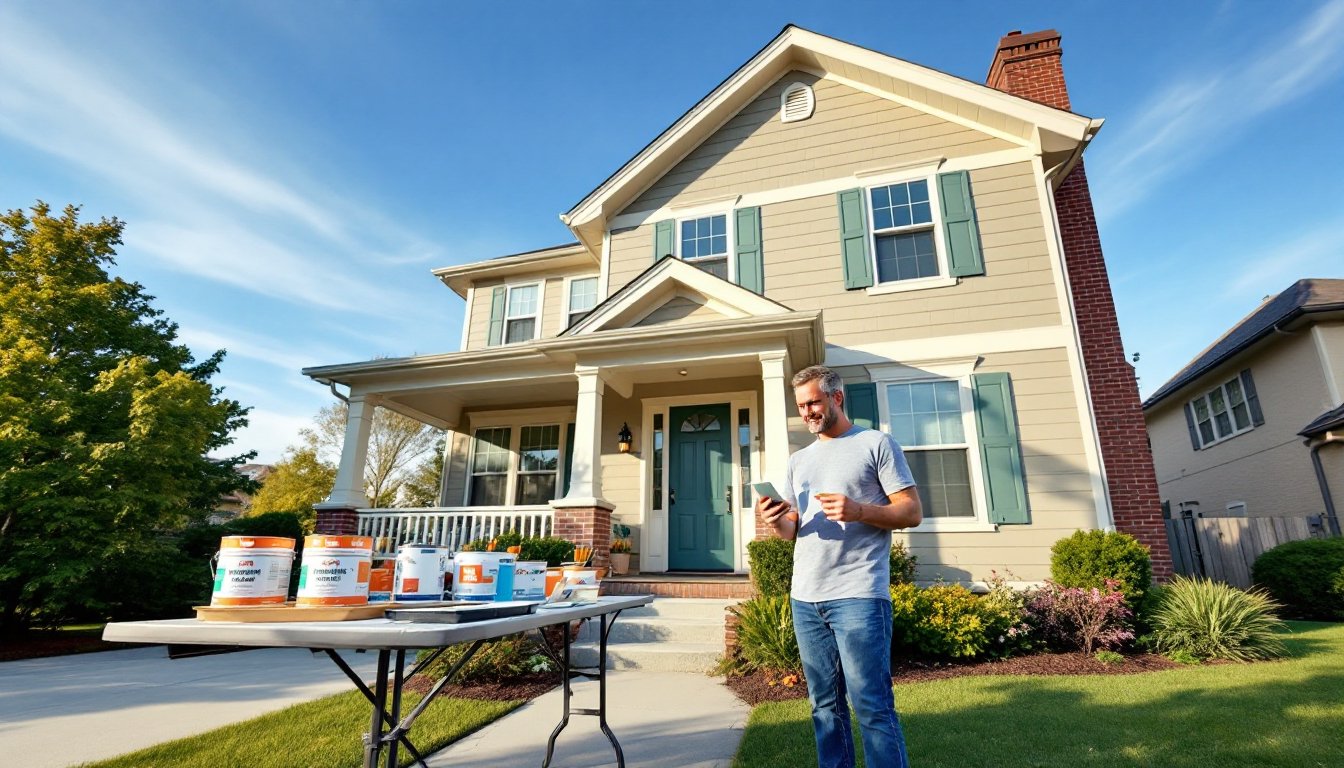
Home Depot also provides free paint samples (usually 8 oz. pints) so homeowners can test colors on actual siding before committing to gallons. Exterior colors shift dramatically depending on sunlight, surrounding landscaping, and neighboring homes, so testing on north- and south-facing walls is critical.
Top Exterior Paint Color Trends for 2026
Warm neutrals continue to dominate in 2026, but they’re moving away from stark grays toward greiges, taupes, and soft beiges. Colors like Behr’s Elephant Skin (N200-4) and Moth Gray (N360-3) offer modern sophistication without the cold feel of the gray trend that peaked in 2020.
Earthy greens are seeing a major resurgence, particularly sage, olive, and forest tones. These shades work especially well on Craftsman, farmhouse, and mid-century modern homes. Behr’s Back to Nature (S340-5) and Vine Leaf (PPU11-1) are trending picks that pair beautifully with natural wood accents and metal roofing.
Deep, moody blues are replacing the pale blues of the past decade. Think navy, slate, and stormy blue-grays that add drama and contrast, especially when paired with white trim. These colors hide dirt better than lighter shades and provide a striking backdrop for colorful landscaping, as seen in many budget home renovation stories.
Warm whites and creams remain timeless, but 2026 leans toward off-whites with subtle undertones, think warm ivory, almond, and linen rather than stark white. Behr’s Swiss Coffee (12) and Cottage White (1813) are go-to choices that won’t yellow over time.
Black and charcoal exteriors are still niche but growing, particularly on modern builds and barn-style homes. These require high-quality paint with UV inhibitors to prevent fading, and they absorb more heat, a consideration in hot climates.
Exploring Home Depot’s Best Exterior Paint Brands
Behr Paint & Primer
Behr Premium Plus Ultra is Home Depot’s flagship exterior paint and the most popular choice for DIYers. It’s a 100% acrylic formula with built-in primer, which means most projects need only one or two coats over properly prepped surfaces. Coverage is roughly 250-400 square feet per gallon, depending on surface texture.
Behr offers three main exterior lines:
- Behr Premium Plus Ultra: Best for siding, trim, and doors. Excellent hide and durability. Around $35-45/gallon.
- Behr Dynasty: Premium tier with advanced stain-blocking and mildew resistance. Ideal for coastal or high-humidity climates. Around $50-60/gallon.
- Behr Marquee: Top-of-the-line one-coat coverage with the most durable finish. Best for high-traffic areas and dramatic color changes. Around $55-65/gallon.
All Behr paints include anti-fade technology and are backed by a lifetime limited warranty when applied correctly. They’re low-VOC (volatile organic compounds), making them safer for enclosed porches and attached garages.
Glidden and PPG Options
Glidden is Home Depot’s budget-friendly brand, and it’s a solid choice for rental properties, sheds, or projects where cost is the main concern. Glidden Premium Exterior runs around $20-28/gallon and offers decent coverage, though it typically requires a separate primer and two coats for full hide.
For homeowners seeking professional-grade performance, PPG paints are available through special order at most Home Depot locations. PPG Manor Hall is a 100% acrylic paint popular among contractors for its smooth application and excellent leveling. It’s pricier (around $40-50/gallon), but the finish quality is noticeably better than entry-level options, which is why it’s often featured in room transformations by experienced DIYers.
PPG also offers Break-Through., a water-based alkyd that mimics the smooth, hard finish of oil-based paints without the smell or lengthy dry times. It’s ideal for front doors, shutters, and trim where durability matters most.
How to Choose the Right Exterior Paint Color for Your Home
Start by identifying fixed elements that won’t change: roof color, brick, stone, walkways, and any neighboring homes in an HOA. The paint color needs to harmonize with these, not fight them. A red-toned brick, for example, looks best with warm neutrals or creamy whites, while gray stone pairs well with cool grays or blues.
Architectural style should guide color choices. Craftsman homes traditionally use earthy tones with contrasting trim (think deep green siding with cream trim). Colonial and Cape Cod styles favor classic whites, grays, and muted blues. Mid-century modern homes can pull off bolder colors, mustard yellow, burnt orange, or teal.
Consider the light exposure on different sides of the house. North-facing walls receive less direct sunlight and can make colors appear darker and cooler. South-facing walls get intense sun, which can wash out pale colors and cause darker shades to fade faster. Test samples on all exposures before committing.
Sheen matters on exterior surfaces. Flat and matte finishes hide imperfections on siding but don’t clean as easily. Satin and eggshell are the most popular for siding, they offer some washability and a subtle glow without looking too glossy. Semi-gloss is standard for trim, doors, and shutters because it’s durable and easy to wipe down. High-gloss is rarely used on exteriors except for accent details like metal railings.
Homeowners should also think about long-term resale. Bold, trendy colors can personalize a home but may narrow the buyer pool. Neutrals and classic shades typically have broader appeal and won’t date the home as quickly, a consideration often highlighted in paint color guides for new construction.
Using Home Depot’s Color Tools and Resources
ProjectColor by The Home Depot is a free app (iOS and Android) that lets homeowners visualize paint colors on their actual home. Snap a photo of the exterior, then digitally “paint” different colors on siding, trim, doors, and shutters. It’s not perfect, lighting and photo quality affect accuracy, but it’s a quick way to rule out colors that clearly don’t work.
The online Color Center at homedepot.com offers curated color palettes by style (Modern Farmhouse, Coastal, Traditional, etc.) and allows users to browse by brand and sheen. Each color page shows LRV (Light Reflectance Value), which indicates how light or dark a color will appear. An LRV of 0 is pure black: 100 is pure white. Colors with an LRV below 50 will read as darker and absorb more heat.
In-store color consultations are available at most locations, though availability varies. Associates can help narrow down choices, explain the differences between paint lines, and recommend primers for challenging surfaces like aluminum siding or previously stained wood.
Home Depot also sells peel-and-stick color samples (Samplize and similar brands) that are easier than painting test patches. These 12″x12″ sheets adhere to siding and can be moved around to compare colors in different light. They cost around $6-8 each but eliminate the mess of sample pots and brushes.
For larger projects, consider ordering a color fan deck for Behr or Glidden. These run about $10-15 and include small swatches of every available color, making it easier to compare options side-by-side at home without multiple store trips.